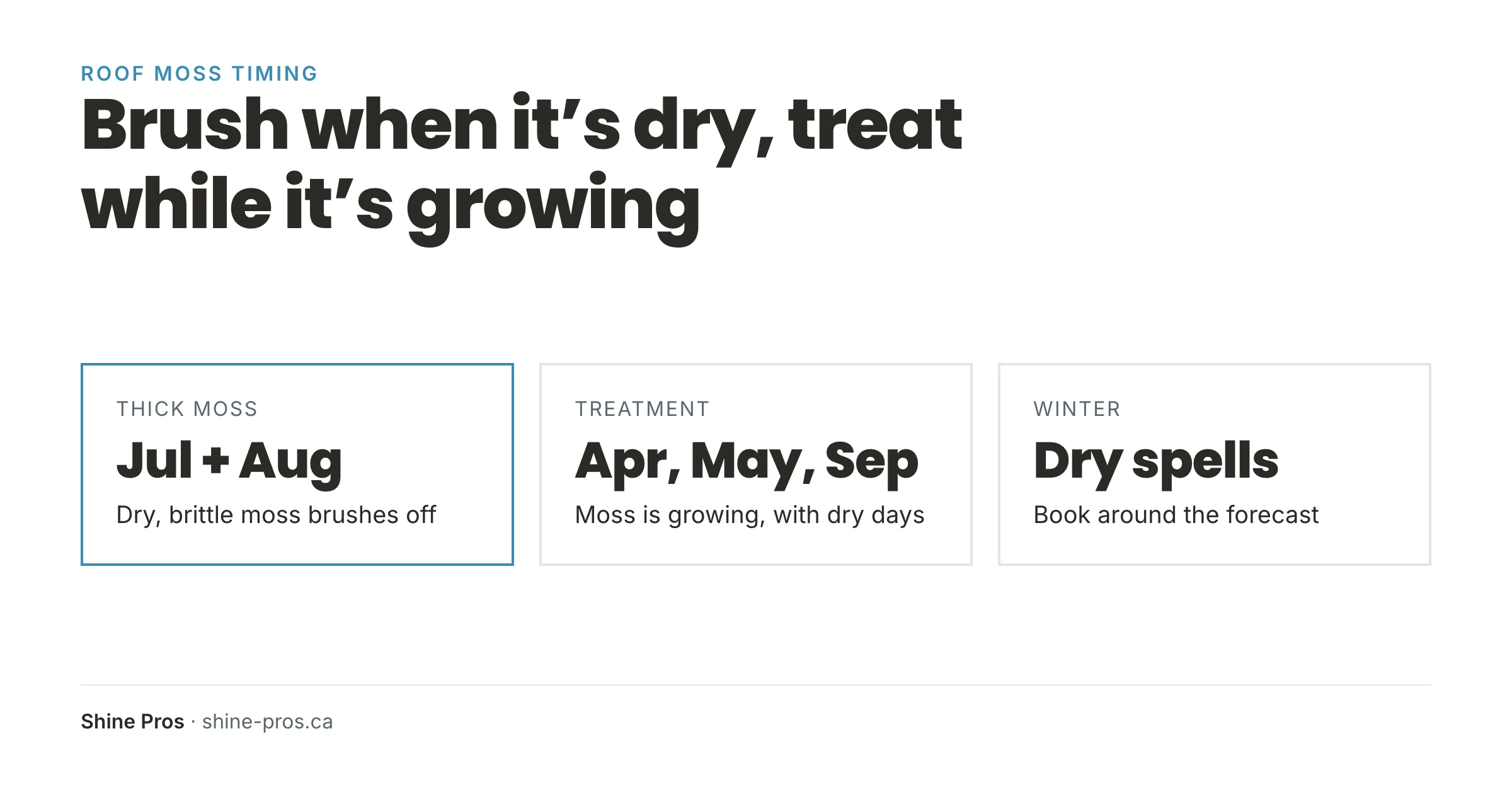
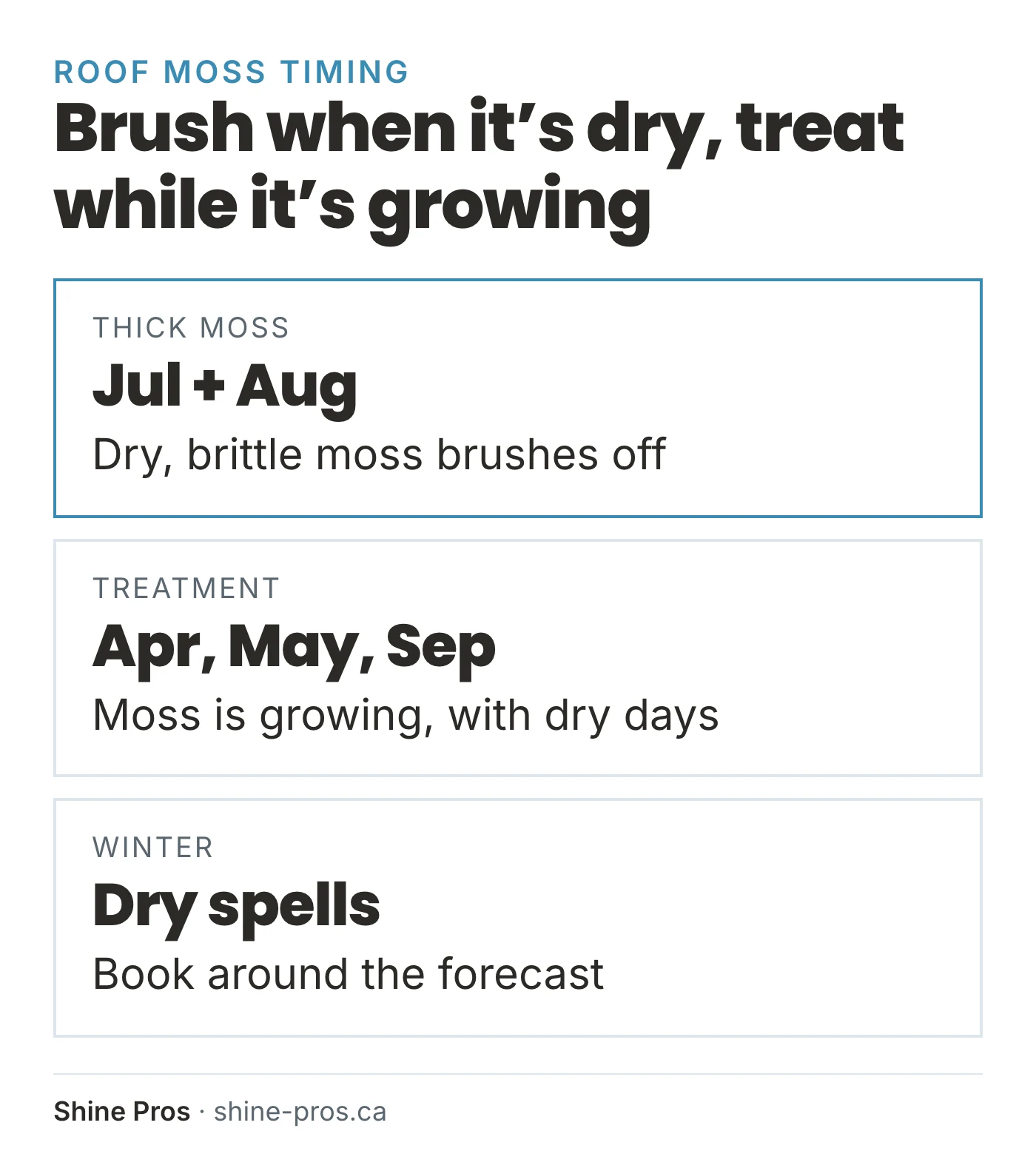
The best time of year to remove moss from a roof in Victoria is July and August if the moss is thick, and spring or early fall if you’re treating it. July and August are the driest months here, with about five days of rain each, so heavy moss dries out and brushes off without tearing the shingles. Treatments work best while moss is actively growing in the cooler months, as long as you get a dry day for them to soak in.
We’re Alex and Emma of Shine Pros, a husband-and-wife exterior cleaning team in Greater Victoria. We’ve cleaned over 200 roofs since August 2022, and we book roof moss removal year-round, weather permitting. Here’s how the calendar actually plays out on a Victoria roof, month by month.
What is the best time of year to remove moss from a roof?
It depends on whether you’re removing moss or killing it, because the two jobs want opposite conditions.
- Removing thick moss: dry weather. Dry moss is brittle and lets go of the shingle. Wet moss is a heavy, slippery mat that smears, holds on, and pulls granules off with it. In Victoria that points to late June through early September.
- Treating moss and preventing regrowth: spring or early fall. Moss is growing then and takes up a treatment better than dormant summer moss does. The catch is rain: most products need a dry window after they go on, so watch the forecast, not just the calendar.
- Doing both: most roofs need both, which is why a proper roof clean is a brush-off and a treatment in one visit, timed for a dry stretch.
Month by month: roof moss removal in Victoria
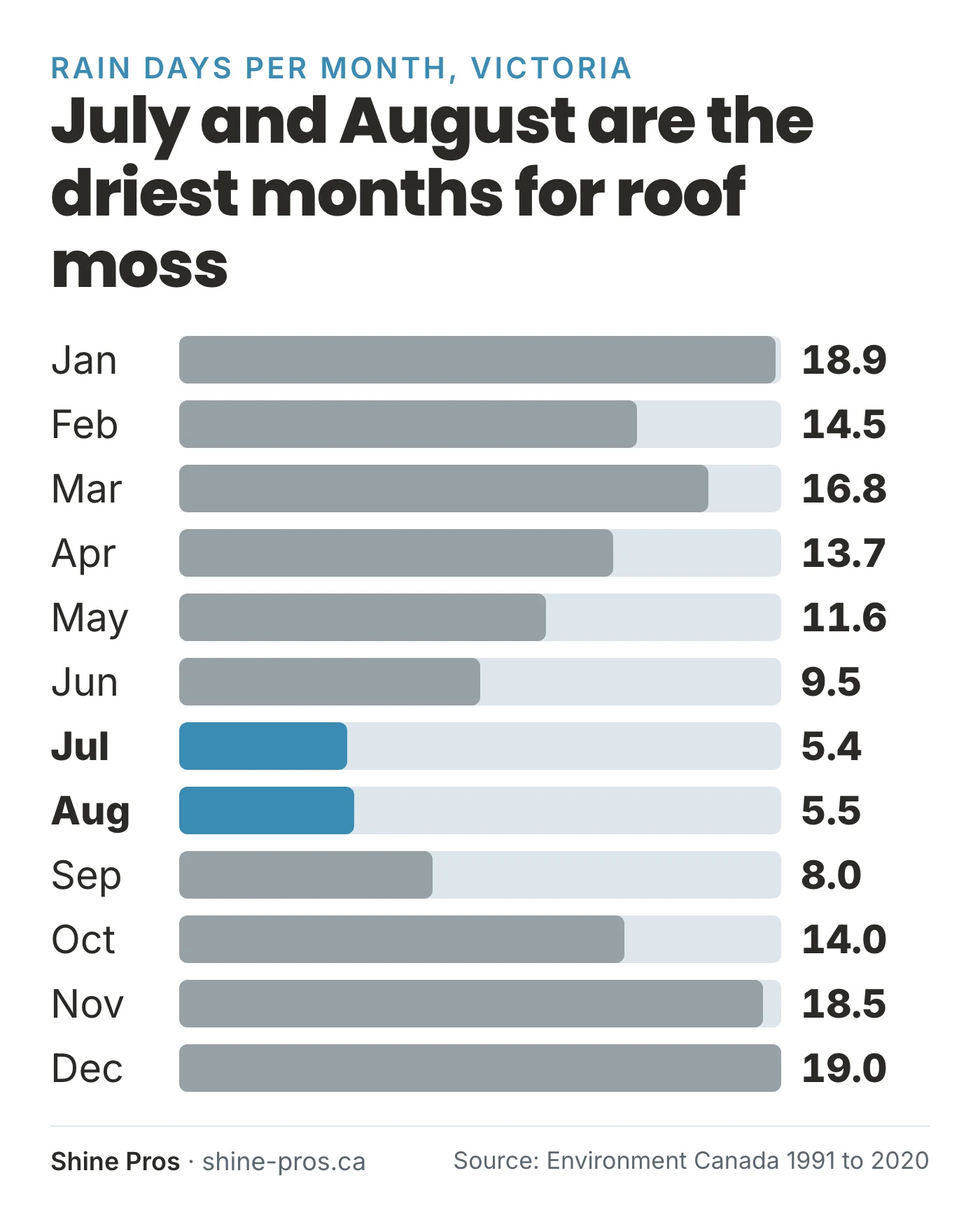
These are Environment Canada’s 1991 to 2020 climate normals for Victoria Airport, the official long-term averages. The rain-day count is the number that matters on a roof, because it decides whether you get the dry days a moss job needs.
| Month | Avg rain days | Avg rain | On the roof |
|---|---|---|---|
| January | 18.9 | 144 mm | Wettest month. Moss is soaked and growing. Possible in a dry spell, rarely ideal. |
| February | 14.5 | 79 mm | Still wet. Good time to book a spring slot and get a quote. |
| March | 16.8 | 76 mm | Moss growing fast. Treatment works well if you catch a dry day. |
| April | 13.7 | 48 mm | Rain easing. Good month for a brush-off and treatment together. |
| May | 11.6 | 37 mm | Drying out. One of the best treatment months. |
| June | 9.5 | 29 mm | Moss drying and brittle. Good for removal. |
| July | 5.4 | 20 mm | Driest month. Best for heavy moss removal. |
| August | 5.5 | 24 mm | Nearly as dry as July. Also good for heavy moss. |
| September | 8.0 | 36 mm | Still dry, moss starting to wake up. Good for removal and treatment. |
| October | 14.0 | 96 mm | Rain returns. Last easy window before winter, and gutters fill with needles. |
| November | 18.5 | 142 mm | Wet. Work around dry days only. |
| December | 19.0 | 137 mm | Wet and short days. Dry spells only. |
Source: Environment and Climate Change Canada, Canadian Climate Normals 1991 to 2020, Victoria (Airport). Rain days are days with at least 0.2 mm of rain.
Can you remove roof moss in winter in Victoria?
Yes, in a dry spell. Victoria’s winters are mild (the January daily average is 4.6°C), so frozen shingles are rarely the problem. Rain is. With about 19 rain days a month from November to January, the work comes down to catching two or three dry days in a row. We book roof work year-round for that reason and move jobs when the forecast turns. If moss is already lifting shingles or blocking your gutters, waiting for July isn’t worth the damage.
When is the best time to apply moss killer on a roof?
When the moss is growing and the forecast gives you a dry window. In Victoria that usually means April and May, or September. Moss killer applied to dormant, dried-out summer moss works more slowly, and moss killer applied just before a rainy week washes off before it does much. Read the label for how long your product needs to stay dry, and keep it out of garden beds and downspouts that drain to them.
Zinc or copper strips along the ridge help slow regrowth after a clean. They don’t remove moss that’s already there.
Is the timing different for roof tiles, metal or flat roofs?
The calendar is the same, the method isn’t. Concrete and clay tiles hold moss in the gaps between them and can crack underfoot, so they need more care, not a different month. Metal roofs are slippery wet or dry; we cover them on our metal roof cleaning page. Flat roofs often hold water after rain, so the dry months matter even more for getting the surface clean. We clean all three.
Moss, algae or lichen: does it change the timing?
Moss is the green, spongy growth that lifts shingles. Algae is the black streaking you see running down the slope. Lichen is the crusty, flat patches that grip hardest. All three like Victoria’s wet winters. Moss is the one that needs a dry day to brush off. Algae streaks come off with a soft wash and treatment, so their timing is mostly about the forecast.
What does quality roof moss removal include?
Good timing only helps if the method is right. Cheap moss removal tends to mean a metal brush or a pressure washer on the shingles, and no fall protection. Here’s what our roof moss removal in Victoria includes:
- A soft wash, never high pressure on shingles, and gentle hand brushing. Never a metal brush.
- A treatment to kill what’s left at the roots and slow regrowth.
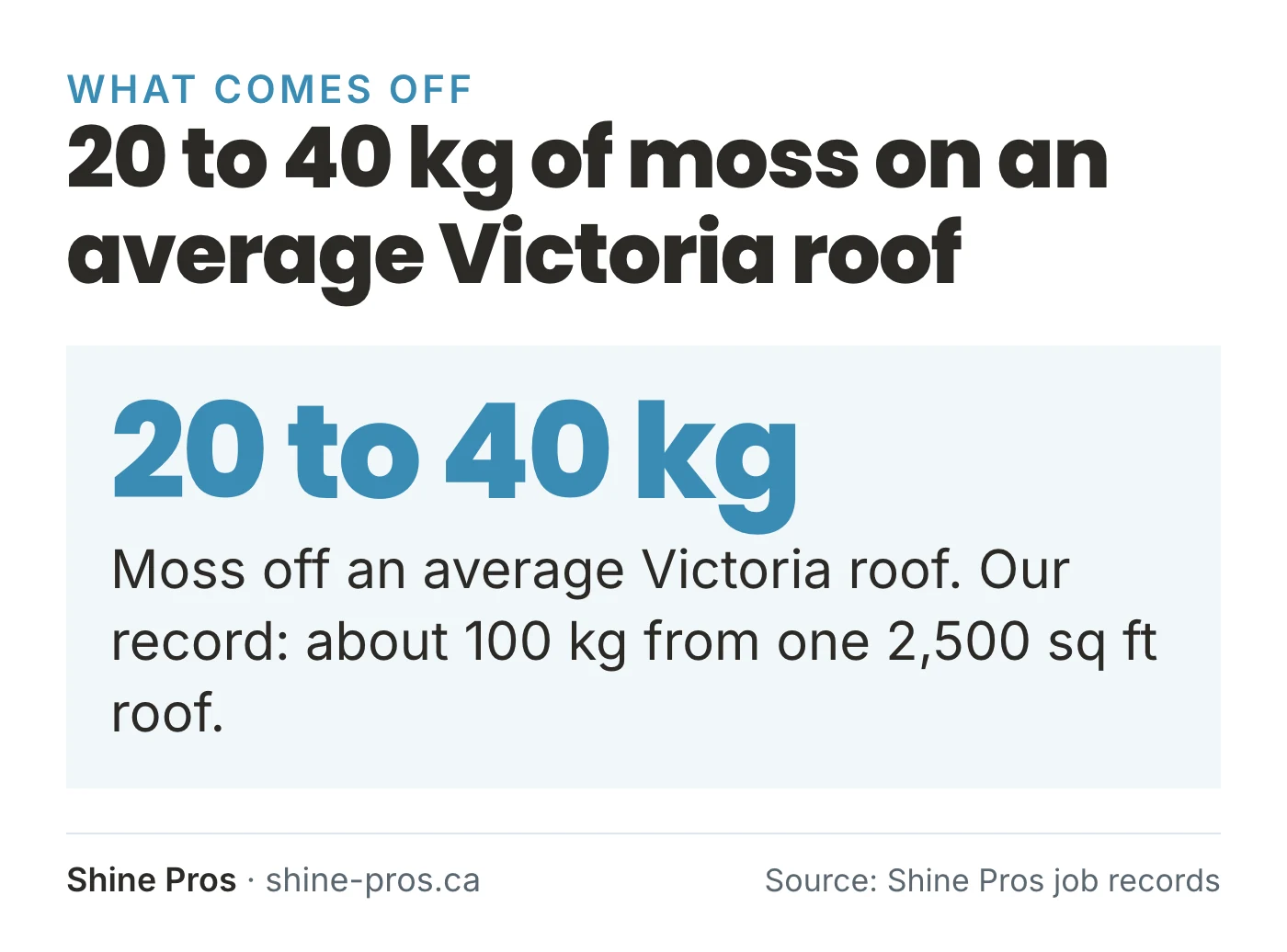
- Full clean-up. We take 20 to 40 kg of moss off an average Victoria roof, and none of it gets left in your garden beds or rock.
- Debris hauled away, and a walk-around with you at the end.
- A two-year moss-free guarantee. If we miss a spot, we come back and fix it at no charge.
Roof cleaning and moss removal starts at $600. A 2,000 sq ft roof runs about $626 with light moss and about $1,000 with heavy moss. The full breakdown is in how much roof moss removal costs in Victoria, or try the roof cleaning cost calculator. If you’d rather do it yourself, read how to remove moss from your roof first.
We carry $3 million in liability coverage and are in good standing with WorkSafe BC. Get an exact price on our free quote form or call (778) 743-4377. Thanks for reading.
Questions about the best time to remove roof moss
What month is best to remove moss from a roof in Victoria?
July and August for thick moss, since they average only about five rain days each. April, May and September are best for treatment.
Is it better to remove moss from a roof when it’s wet or dry?
Dry. Dry moss is brittle and lets go of the shingle. Wet moss smears, holds on and pulls granules off with it, and a wet roof is far more slippery to work on.
Do you remove roof moss in winter?
Yes, weather permitting. We book roof work year-round and schedule around dry spells, and move the job if the forecast turns.
What is the best time to clean moss off roof tiles?
The same dry summer window as shingles. Tiles need more care because they can crack underfoot and moss packs into the gaps between them.
Does moss really damage a roof?
Yes. It holds water against the roof long after the rain stops and lifts shingles as it grows. More in how roof moss shortens roof lifespan.