
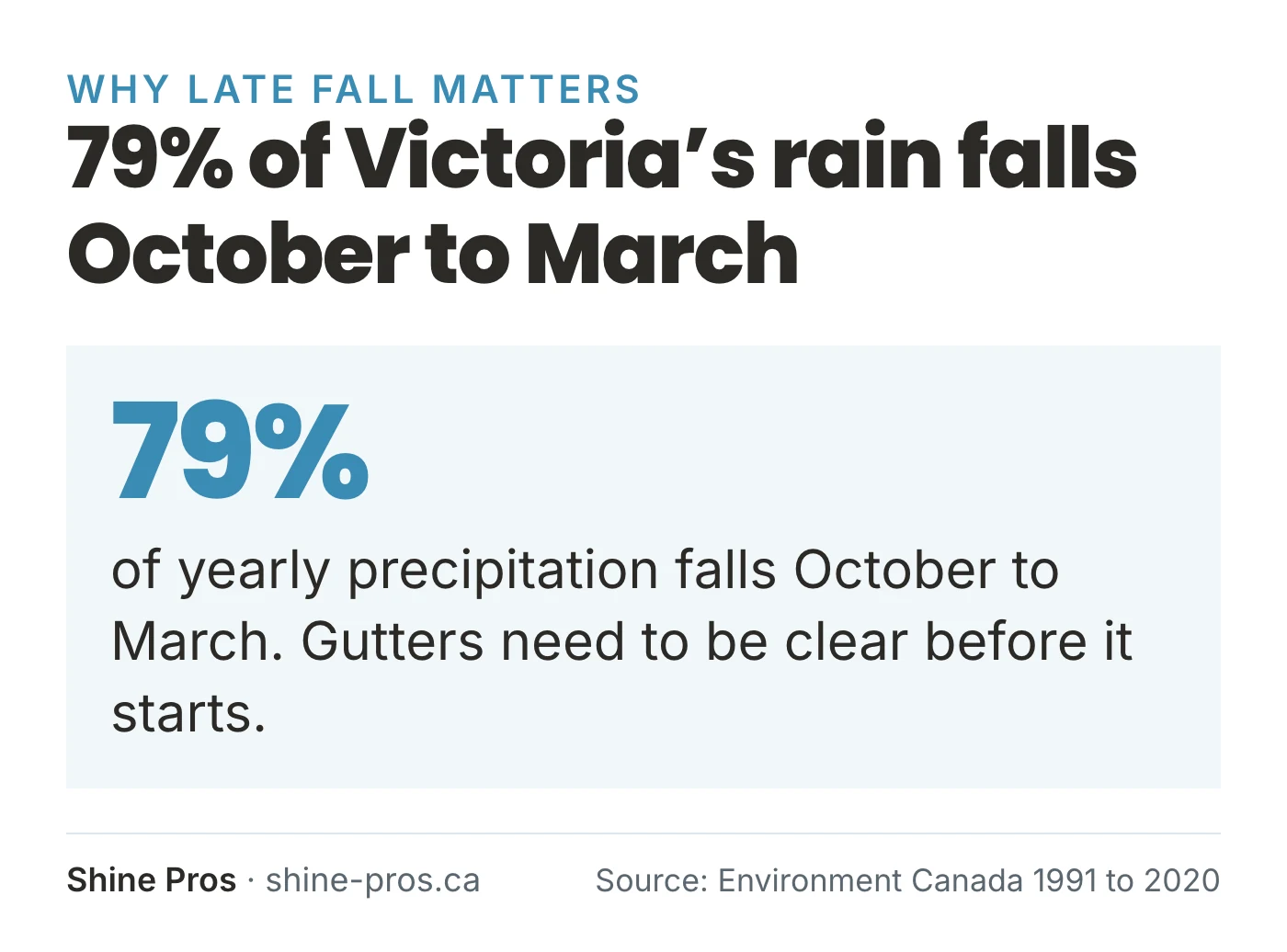
Most Victoria homes should have their gutters cleaned twice a year: once in late fall after the leaves are down, and once in late spring. If you only do it once, make it late fall, because about 79% of Victoria’s rain falls between October and March. Homes under big firs, cedars, maples or Garry oaks often need three or four cleanings a year. Homes with no trees nearby can sometimes get away with one.
We’re Alex and Emma of Shine Pros, a husband-and-wife exterior cleaning team in Greater Victoria. We’ve cleaned gutters on over 250 homes since August 2022, and an average set holds 20 to 30 kg of needles, moss and grit by the time we get to it. Here’s how to work out the right gutter cleaning frequency for your house.
How often should gutters be cleaned in Victoria?
Twice a year is the right answer for most houses here, but the trees around your roof matter more than any rule of thumb.
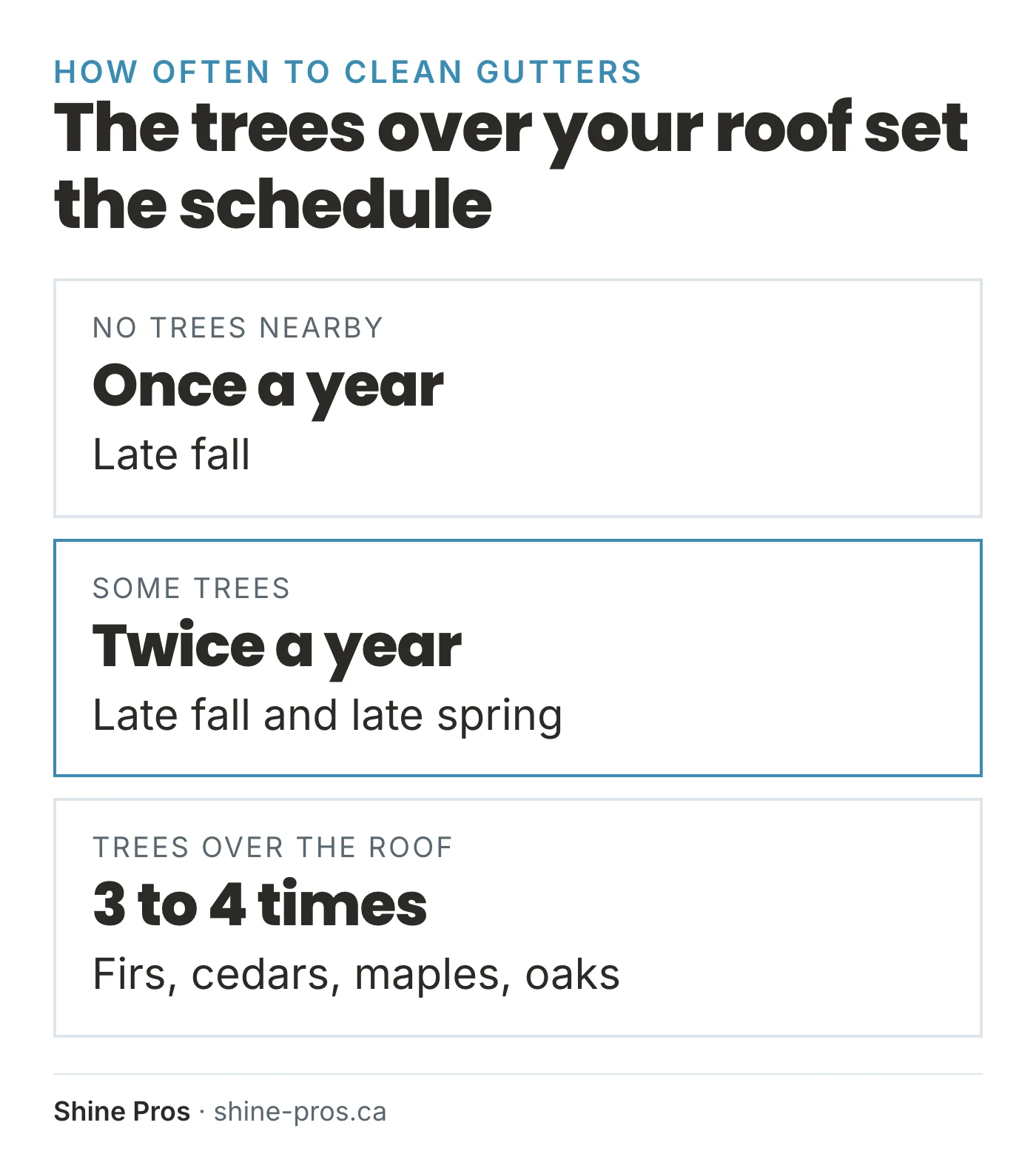
- No trees over or near the roof: once a year, in late fall, can be enough. Moss and roof grit still build up even without leaves.
- A few trees nearby: twice a year, late fall and late spring.
- Trees overhanging the roof: three or four times a year. Douglas firs and cedars drop needles through the year, big-leaf maples and Garry oaks dump leaves in October and November, and cottonwoods and alders shed seeds and catkins in late spring.
Most general advice online is written for places with snow and ice dams. Victoria rarely freezes. Our problem is volume: the airport averages 146 mm of rain in November and 155 mm in January, and a gutter that’s half full of needles can’t carry that.
When is the best time to clean gutters in Victoria?
Late fall is the one that matters most, once the deciduous leaves are down and before the heaviest rain. Late spring is the second, to clear blossoms, seeds and the moss that grew over winter. Here’s how the year plays out in a Victoria gutter:
| Months | Avg rain | What’s in your gutters | What to do |
|---|---|---|---|
| March to April | 76 mm, 48 mm | Winter debris loosens, moss growing, first blossoms fall | Check for winter damage and overflow |
| May to June | 37 mm, 29 mm | Cherry blossoms, cottonwood fluff, alder catkins, pine needles | Spring cleaning. Flush downspouts |
| July to August | 20 mm, 24 mm | Dry season, little new debris, birds may nest in downspouts | Quick look only |
| September | 36 mm | First leaves and acorns drop | Book your fall cleaning |
| October to November | 96 mm, 146 mm | Heavy leaf drop from maples and Garry oaks, rain returns | Fall cleaning, the most important one |
| December to February | 146 mm, 155 mm, 85 mm | Gutters carrying the most water of the year, moss keeps growing | Watch for overflow during heavy rain |
Rain figures: Environment and Climate Change Canada, Canadian Climate Normals 1991 to 2020, Victoria (Airport), average precipitation per month.
Should I clean my gutters every year?
Yes. Even a house with no trees nearby collects roof grit, moss and wind-blown debris, and one blocked downspout is enough to send water over the edge. Skipping a year in Victoria usually means the gutter is packed by the next November rains. If you’re weighing whether it’s worth paying for, we lay out the case in do I actually need my gutters cleaned regularly.
Signs your gutters need cleaning now
Don’t wait for the calendar if you see any of these.
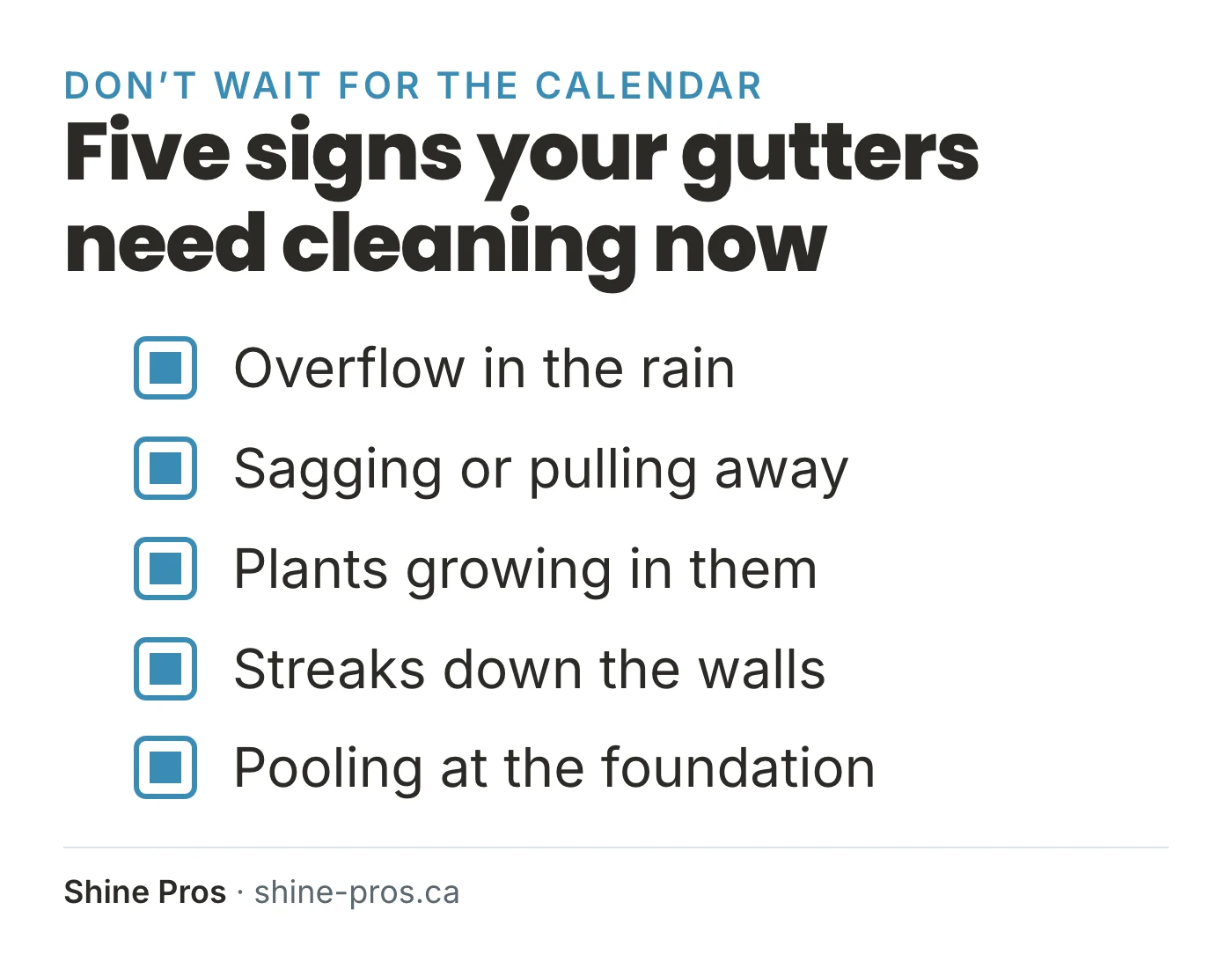
- Water spilling over the front edge in the rain. Stand outside in a moderate rain and watch the roofline. It’s the easiest sign to spot.
- Sagging, or gutters pulling away from the fascia. Wet debris is heavy, and the weight pulls the hangers loose.
- Plants or ferns growing out of the gutter. That means there’s enough soil in there to hold roots. We once cleaned gutters in Brentwood Bay with ferns growing out of them.
- Dark streaks running down the walls under the gutter, from water overflowing behind it.
- Water pooling or soil washing out at the foundation. The water isn’t reaching the downspouts.
How to maintain gutters at home between cleanings
A few habits stretch the time between cleanings and catch problems early.
- Watch them in the rain. Five minutes during a downpour tells you more than any inspection on a dry day.
- Check the downspout outlets. Make sure water comes out the bottom at full flow. If it trickles, the downspout is partly blocked.
- Clear the downspout opening from the ground where you can reach it, so leaves don’t pile over it.
- Trim branches back from the roof. Less overhang means less debris and more sun to slow moss.
- Look for loose hangers and leaking seams after a windstorm.
Gutter guards cut down how often gutters fill, but they don’t remove the need to clean them. Fine needles and roof grit get through or sit on top, and guards still need to be checked and cleared. For eavestrough-specific upkeep, see how to maintain your eavestroughs in Victoria.
DIY or professional gutter cleaning?
On a single-storey home with easy access, cleaning your own gutters twice a year is a reasonable job: a sturdy ladder, gloves, a scoop, a bucket and a hose, with someone to foot the ladder. Two-storey homes, steep or complicated rooflines and gutters over sloped ground are where we’d suggest handing it off. Our guide to cleaning high gutters safely covers where that line is.
Here’s what our gutter cleaning in Victoria includes:
- Every channel cleared by hand, using ladder standoffs so no ladder rests on your gutters.
- Downspouts flushed and tested.
- Debris bagged and hauled away. Nothing left in your beds.
- A walk-around with you at the end, and if we miss a spot we come back and fix it at no charge.
Gutter cleaning runs $235 for a 1,500 sq ft single-storey to $448 for a 3,500 sq ft two-storey; see how much gutter cleaning costs in Victoria for the breakdown. We have cul-de-sacs where we look after four or five neighbours, year after year. Get an exact price on our free quote form or call (778) 743-4377. Thanks for reading.
Questions about how often to clean gutters
How often should you clean your gutters in Victoria?
Twice a year for most homes, in late fall and late spring. Three or four times a year if firs, cedars, maples or oaks hang over the roof. Once in late fall can be enough with no trees nearby.
What month should I clean my gutters?
November, once the leaves are down and before the wettest months. If you clean twice a year, add May or June for blossoms, seeds and spring moss.
Do you still need to clean gutters if you have gutter guards?
Yes, less often. Fine needles, seeds and roof grit get past most guards or sit on top of them, so they still need checking and clearing.
How often should eavestroughs be cleaned?
Eavestroughs are the same thing as gutters, so the same schedule applies: twice a year for most Victoria homes. More on the word itself in what is an eavestrough.
How long does a gutter cleaning take?
It depends on the size of the house and how full the gutters are. We break down real times in how long gutter cleaning takes.






One Response