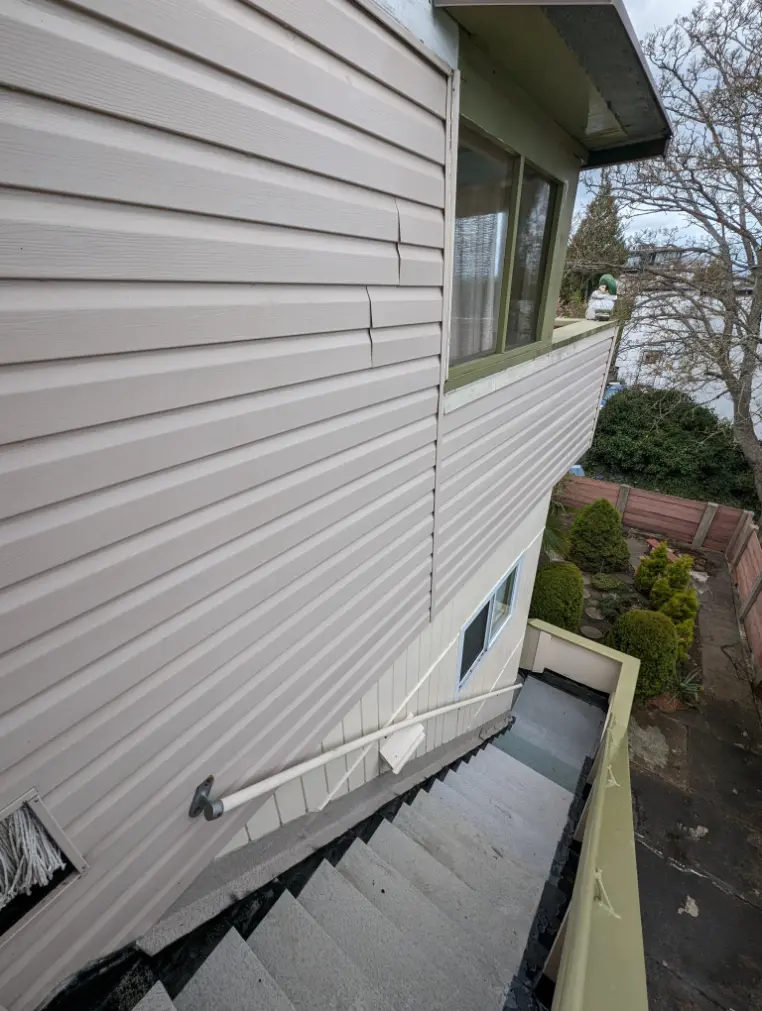
Yes. Most Victoria homes need their gutters cleaned twice a year, once in late fall and once in late spring, because a blocked gutter sends rain down your walls and against your foundation instead of out the downspout. Homes under big firs, cedars or maples often need three or four cleanings a year.
We’re Alex and Emma of Shine Pros, a husband and wife crew, and we’ve cleaned gutters on over 250 Victoria homes since August 2022. An average set gives up 20 to 30 kg of needles, moss and leaves by the time we get to it, and a gutter can look fine from the ground right up until it overflows.
Do I actually need to have my gutters cleaned regularly?
Yes, gutters need regular cleaning to protect your home from water damage. In Victoria, BC, you should clean gutters at least two times per year. Clean them once in late fall after leaves drop. Clean them again in spring after seeds and flowers fall.
Do you have Douglas fir, cedar or oak trees near your house? You may need to clean gutters 3 to 4 times each year. Our coastal weather brings heavy rain, moss and lots of debris, and that clogs gutters faster than in drier places.
What happens if you skip cleaning? You could get foundation damage, roof leaks, a wet basement and bug problems. At Shine Pros, a gutter cleaning in Victoria costs $235 to $448, depending on the size and height of the home. Paying for regular cleaning costs much less than paying for any of those repairs.
Not sure if your gutters need attention? Booking regular gutter cleaning in Victoria gets someone up there to look.
Why your home has gutters (and why they matter)
Gutters catch the rain coming off your roof and send it away from the house through the downspouts. Many homeowners don’t think about them until something goes wrong, so it helps to know what they’re actually doing.
What gutters do for your home
Your gutters move thousands of litres of water away from your home each year. Just 25 mm of rain on a 2,000 sq ft roof is roughly 4,700 litres of water. Without gutters, all that water pours down your walls and pools around your foundation.
Most of Victoria’s rain falls between October and March. That’s months of steady rain, and your gutters handle all of it.
What water damage looks like
When gutters don’t work right, serious problems happen.
Foundation damage happens when water pools against your foundation walls. The soil gets soaked and swells, which pushes on the walls and can crack them. Water then leaks through those cracks into your basement.
Roof damage happens when clogged gutters make water back up under your shingles. This water rots the wood under them, and you might not see it until water stains show up on your ceiling.
Landscaping suffers too. Without gutters moving water away, rain digs channels in the soil, washes away plants and leaves muddy spots that stay wet all through our rainy season.
Working gutters stop all of this. That’s why regular cleaning isn’t optional for most Victoria homes.
How often should gutters be cleaned in Victoria?
The standard rule is to clean gutters at least two times per year.[1] But Victoria’s weather and trees mean some homes need more cleaning.
Basic cleaning schedule
For most Victoria homes, plan on two cleanings each year.
The late fall cleaning (October to November) removes leaves before the heavy winter rain. Maples, oaks and alders drop their leaves in October, so cleaning in early November gets your gutters ready for the wettest months.
The spring cleaning (April to May) clears out spring debris. Cherry blossoms, cottonwood seeds and needles all come down in spring, and a May cleaning gets your gutters ready for the drier summer.
When you need more cleanings
Some Victoria homes need cleaning 3 to 4 times per year. Here’s when you need extra cleanings.
Heavy tree coverage is the big one. Do you have trees hanging over your roof, or within 20 feet of your home? Debris builds up faster. Douglas fir needles fall all year long, cedar drops small debris constantly, and oaks drop leaves and acorns.
Different trees make different problems:
- Douglas fir and pine drop needles that stick together and block water
- Cedar debris holds water and helps moss grow
- Oak leaves and acorns create thick clogs
- Maple seeds pile up fast in spring
- Cottonwood seeds clog gutters in May
Shady spots matter too. Homes in shade get more moss, and moss needs water and shade to grow. Moss growing in your gutters holds water like a sponge and blocks it from draining.
We tell people to clean in late October or early November after the trees drop their leaves, and again in May after the cottonwood seeds and cherry blossoms stop falling. For homes with lots of fir or cedar, add cleanings in July and September.
What about gutter guards?
Gutter guards help reduce debris but don’t stop all cleaning. Guards still need to be checked once a year and cleaned now and then, because small debris like needles and roof grit can still get through most guard systems.
Here’s a guide for how often to clean based on your trees:
| Tree coverage | Cleanings per year | Best times |
|---|---|---|
| No nearby trees | 1 to 2 times | Fall only, or fall plus spring |
| Light coverage (1 to 2 trees) | 2 times | Fall plus spring |
| Moderate coverage (3 to 5 trees) | 2 to 3 times | Fall plus spring plus mid-summer |
| Heavy coverage (6 or more trees, or hanging over the roof) | 3 to 4 times | Fall plus spring plus summer plus early fall |
| Gutters with guards | 1 time | Check once a year, clean when needed |
There’s more detail on how often gutters should be cleaned for your home, worth reading before the fall rains start.
What actually happens if you don’t clean your gutters
Clogged gutters overflow, and the water goes where your house isn’t built to take it. These are the problems that follow.
Foundation damage and bigger problems
When gutters overflow, water pours down the walls and pools against your foundation. During Victoria’s wet season, that means the soil around your foundation stays soaked for months.
Soaked soil swells and pushes on the foundation walls, and that pressure causes cracks. Water leaks through the cracks into your basement. Once water gets into your foundation, you face several problems:
- Water coming in through cracks, leaving standing water or keeping everything damp
- Mould in damp basements, which affects the air through the whole house
- Foundation movement that cracks walls and ceilings upstairs
- A red flag for buyers when you sell
Roof damage and inside water leaks
Clogged gutters create standing water along your roofline, and that water backs up under your shingles. Shingles are made to shed water flowing down the roof. They aren’t made to keep water from flowing backward underneath them.
When water gets under shingles, it soaks into the roof deck. That wooden platform under your shingles wasn’t made for constant water, so it rots, and as the rot spreads your roof gets weaker.
Signs of roof damage from gutter problems include:
- Water stains on ceilings, especially near outside walls
- Peeling paint on roof trim boards
- Visible rot on roof boards
- Damp attic insulation
- Missing or curled shingles along roof edges
Basement and crawl space water damage
Even if your foundation doesn’t crack, very wet ground around your home creates pressure. This is the force of water in the soil pushing against your foundation walls.
That pressure forces water through any weak spot in your foundation, including:
- Tiny holes and small cracks in concrete
- Gaps around pipes and wires
- Joints between the foundation wall and the floor
- Cracks in the foundation base
Once water gets into your basement or crawl space, you’re paying for water removal, drying, mould cleanup and waterproofing, and none of that is cheap.
Bug problems and health risks
Standing water and debris in gutters make good homes for pests:
- Mosquitoes breed in standing water
- Wasps and hornets build nests in debris-filled gutters
- Birds nest in gutters full of twigs and leaves
- Rodents use gutter debris for nesting and as a road to your attic
- Ants are drawn to the wet wood of rotting trim boards
Trim board damage
Your fascia (the boards behind your gutters) and soffits (the underside of your roof overhang) are usually wood, and wood wasn’t made for constant water.
When gutters overflow, water runs down the fascia. Constant water causes:
- Wood rot that weakens the boards
- Peeling paint
- Fascia pulling away from the roof
- Soffit staining and falling apart
If rot spreads to the rafters behind the fascia, the repair gets much bigger. Compare all of that to two professional cleanings a year at Shine Pros, which come to $470 to $896 depending on the size of your home.
Warning signs your gutters need cleaning right now
You don’t need to climb a ladder to spot gutter problems. Watch for these warning signs that tell you your gutters need help right away.
Clear visual signs
Water overflowing during rain is the clearest sign your gutters are clogged. During a November downpour, watch your gutters. Water should flow through them and out the downspouts. If it pours over the edges like a waterfall, you have clogs, and damage may already be starting on the fascia and around the foundation.
Sagging gutters, or gutters pulling away from the house, mean serious problems. Clogged gutters full of water and debris get very heavy, and the weight pulls them away from the fascia. You’ll see gaps between the gutter and the roofline.
Plants growing in your gutters mean debris has been there long enough for seeds to sprout. One Brentwood Bay home we cleaned had ferns growing out of its gutters. If you can see green plants from the ground, your gutters haven’t been cleaned in years.
Signs from ground level
Staining on your siding below the gutters shows water has been overflowing a lot. Look for lines or colour changes running down from the roofline.
Birds, wasps or other bugs around your roofline mean they’ve found nesting spots in your gutters. Watch for birds flying under the overhang, or wasps hanging around near the roofline.
Debris you can see from the ground means your gutters are really clogged. If leaves, branches or needles are sticking out of them while you’re standing on the lawn, the clog is bad.
Inside warning signs
Water marks or dampness in your basement during rainy weather show water isn’t being moved away from your foundation. Check the basement walls and floor near outside walls after heavy rain.
Peeling paint on fascia or soffits happens when constant water gets behind the paint. The wood underneath swells and shrinks, which makes the paint crack and peel. This often shows up before you see actual rot.
A mildew smell in your basement or crawl space suggests water problems. It could have several causes, but overflowing gutters are a common one.
Seasonal warning signs
After the fall leaf drop (November in Victoria), check for these signs:
- Gutters look full from ground level
- Debris visible on the roof near the gutters
- Water still sitting in the gutters days after the last rain
After the spring blooms (May in Victoria), watch for:
- White cottony buildup (cottonwood seeds)
- Pink or white petals (cherry blossoms)
- Needles or cones in the gutters
Use this checklist for a quick gutter check:
- Water overflows during rain
- Gutters sag or pull away from the house
- Plants or moss growing in the gutters
- Stains on the siding below the gutters
- Birds or wasps nesting near the roofline
- Basement dampness during rainy weather
- Peeling paint on fascia or soffits
- Debris visible from ground level
- Gutters haven’t been cleaned in 2 or more years
- A recent storm brought down branches or heavy debris
If even one of these is true, your gutters need cleaning. Several at once means it’s time to get help soon.
Professional cleaning or DIY: what makes money sense?
Plenty of Victoria homeowners think about cleaning their own gutters to save money. Here’s what each choice really involves.
What professional gutter cleaning costs
Shine Pros charges $235 for a 1,500 sq ft single-storey home up to $448 for a 3,500 sq ft two-storey home, and you get the exact number before work starts. The price depends on:
- Home size (how much gutter there is)
- Height (one storey or more)
- Tree coverage and how much debris there is
- Hard to reach spots
Our gutter cleaning includes:
- All debris taken out by hand
- Every downspout flushed and flow tested
- Debris bagged and hauled away, with nothing left in your garden beds
- Ladders on standoffs, $3 million in liability coverage and WorkSafe BC in good standing
- A walk-around with you at the end
For cleaning two times each year, that’s $470 to $896 per year.
What DIY gutter cleaning takes
DIY isn’t free. Here’s what you’ll need:
- A sturdy extension ladder, bought or rented
- A ladder standoff, so the ladder rests on the roof and not the gutter
- Gloves and safety glasses
- A gutter scoop or small plastic trowel
- A bucket or bag for the debris
- A garden hose with a spray nozzle
Then there’s the time: setting up and moving the ladder over and over, scooping, bagging, flushing the downspouts and cleaning up after.
The safety issue
This is where DIY costs get serious. Common ladder accidents include:
- Falls when the ladder tips because you reached too far sideways
- Slips on wet rungs
- The ladder sliding on soft ground
- Losing balance from overreaching
- The ladder touching power lines
We’ve seen what happens. One of our customers, unhappy with the mess her last company left, tried cleaning her own gutters. She fell and broke her back.
What professional service includes that DIY doesn’t
We use ladder standoffs, which keep the ladder off your gutters and siding and make the work safer for us. We flush every downspout and run water through to prove it drains, then clean up so no debris lands in your plants or on your property.
Most people cleaning their own gutters take out the visible debris and skip the flow test. That step is what tells you the gutters actually work.
When DIY makes sense
If you’re comfortable on a ladder and know what you’re doing, Alex will tell you to go for it. DIY gutter cleaning can work if:
- You have a small, one-storey home
- You’re physically able and comfortable on ladders
- Your gutters have little debris
- You have the right safety gear
- You have time to do the job right
Before you start, read the most effective way to clean gutters step by step.
When professional service makes more sense
Professional cleaning is the better choice if:
- You have a two-storey or taller home
- You’re uncomfortable with heights or ladder work
- You have physical limits
- Your gutters haven’t been cleaned in 2 or more years
- You have heavy tree coverage
- Your property has hard to reach areas
For gutters up high, here’s how to clean high gutters safely and where that stops working.
The long-term comparison
| Factor | Shine Pros | DIY |
|---|---|---|
| Equipment | None needed | Ladder, standoff, gloves, scoop, bucket, hose |
| Cost, two cleanings a year | $470 to $896 | Your time |
| Who’s on the ladder | Insured crew on standoffs | You |
| Downspouts | Flushed and flow tested | Depends what you know |
| If a spot is missed | We come back and put it right at no extra cost | Back up the ladder |
Check what gutter cleaning costs across Victoria for the full price breakdown.
The best way to keep your gutters working year-round
A cleaning schedule built around your own property protects your home without paying for visits you don’t need.
Build your cleaning schedule around your property
Start by looking at your own situation.
Count your trees. Walk around your property and note how many trees are within 20 feet of your home, especially any that hang over the roof. More trees mean more frequent cleaning.
Know your tree types, since different trees make different problems:
- Douglas fir and pine drop needles year-round, so plan for 3 to 4 cleanings
- Cedar drops small debris constantly, so 3 cleanings is a good target
- Oak and maple have a heavy fall leaf drop, so 2 cleanings at minimum
- Cherry and other fruit trees drop blossoms in spring, so don’t skip the spring cleaning
Note your sun exposure. Shaded areas grow more moss, and moss holds water and blocks drainage, so shaded homes need more frequent cleaning.
Victoria’s seasonal cleaning schedule
For Victoria homeowners, we suggest booking around our seasons.
Spring cleaning (late April to early May) is your after-winter, before-summer cleaning. It works because:
- Cherry blossoms finish falling by late April
- Cottonwood seeds drop in May (wait until after this if you have cottonwoods nearby)
- Spring storms may have blown branches and debris onto your roof
- You want clean gutters before the drier summer months
At this cleaning, remove the blossoms, seeds and twigs, look for winter storm damage, and clear the downspouts.
Fall cleaning (late October to mid-November) is the one that matters most. Schedule it for late October or early November, before the heaviest rain arrives. It works because:
- Trees finish dropping leaves by early November
- Most of Victoria’s rain falls between October and March
- Clear downspouts are ready for the winter volume of water
At this cleaning, remove all the leaves, needles and other debris, look for sagging, and check that water flows through the whole system.
An extra mid-year cleaning in July makes sense if you have heavy Douglas fir, pine or cedar coverage. Dry weather also makes checking and cleaning easier.
An early September cleaning helps homes with a lot of trees that lose their leaves. It clears the summer buildup before fall adds more and makes the main fall cleaning easier.
Setting up your annual maintenance
Set calendar reminders for your cleaning schedule. Most homeowners forget about gutters until they see problems.
Book ahead. Fall is the busy season for gutter cleaning, so book your fall cleaning in September, and book spring cleaning in March for April or May.
Keep records of when the gutters were cleaned and anything found, so you can tell if you need more or fewer visits.
Watch for warning signs between cleanings. Even with regular service, check your gutters after a big windstorm, because wind can fill them with debris fast.
What about gutter guards and covers?
Many homeowners ask if gutter guards stop the need for cleaning. The short answer is no, but they can reduce how often you need to clean.
- Screens and mesh guards still need to be checked once a year
- Small debris, like needles and roof grit, gets through most systems
- Some guards cause problems by trapping debris on top
If you have gutter guards, check them once a year (fall is best), watch for debris building up on top, and make sure water isn’t running over them in heavy rain.
Guards work best on homes with moderate tree coverage. Homes with heavy pine or fir coverage may see less benefit, because fine needles get through most guard systems.
Make your gutters last longer with regular cleaning
Regular cleaning helps gutters last longer by:
- Stopping rust from standing water
- Reducing the weight on hangers and fasteners
- Finding small problems early
- Stopping rot in the fascia
Your action plan
Here’s a step-by-step plan for your Victoria home:
- Check where things stand. When were your gutters last cleaned? Go through the warning signs list above.
- If your gutters haven’t been cleaned in 2 or more years, or you see any warning signs, book a cleaning now.
- Based on your tree coverage, set up 2 to 4 cleanings per year.
- Add reminders 2 to 3 weeks before each target date.
- Book early: September for fall cleaning and March for spring cleaning.
- Write down cleaning dates and anything found for next time.
For Victoria homeowners, we suggest booking the fall cleaning in early October, before the heavy rain. Spring cleaning works best in late April, after the cherry blossoms but before the cottonwood seeds drop.
Common questions
How often should gutters be cleaned in Victoria, BC?
Twice a year for most homes, in late fall and late spring. Homes under big firs, cedars or maples often need three or four cleanings, and a house with no trees nearby can sometimes get away with one.
What happens if you never clean your gutters?
They fill up and overflow, so rain runs down your walls and pools against the foundation instead of leaving through the downspouts. Over time that means rotting fascia, a wet basement or crawl space, and water backing up under the shingles.
How much does gutter cleaning cost in Victoria?
At Shine Pros it’s $235 for a 1,500 sq ft single-storey home and $448 for a 3,500 sq ft two-storey, with downspout flushing and cleanup included. See gutter cleaning cost in Victoria for what changes the price.
Do gutter guards mean I never have to clean my gutters?
No. Fine needles and roof grit get through most guards, and some guards trap debris on top. Check them at least once a year and clean them when needed.
If your gutters are full, overflowing or just not a job you want, book gutter cleaning in Victoria, call (778) 743-4377, or request a free quote online. We work across Victoria, Oak Bay, Saanich, Esquimalt, Langford and nearby, and if we miss a spot, we come back and put it right at no extra cost.
References
[1] U.S. General Services Administration. (2017). General Inspection and Maintenance of Gutters and Downspouts. Historic Preservation Technical Procedures.