
In most BC rentals, gutter cleaning is the landlord’s job. Section 32 of the Residential Tenancy Act makes the landlord responsible for keeping the property in a state of repair that meets health, safety and housing standards, and gutters are part of the building. A tenant only pays when they caused the damage.
That’s the short version. The longer one matters, because BC’s official guidance never actually names gutters, leases sometimes try to shift the job, and strata rentals follow a different set of rules. Everything below is taken from the Act, the Residential Tenancy Branch’s Policy Guideline 1 (July 2025 version) and the Strata Property Act. It’s general information, not legal advice.
What does the Residential Tenancy Act say about gutters?
The Residential Tenancy Act splits the work in section 32. The landlord must “provide and maintain” the residential property so it meets health, safety and housing standards and is suitable for a tenant to live in. The tenant must keep the unit and the rest of the property they use reasonably clean and sanitary.
Two more lines in the same section settle most gutter arguments:
- A tenant has to repair damage caused by their own actions or neglect, or by someone they let onto the property.
- A tenant does not have to repair reasonable wear and tear.
Needles and leaves filling a gutter over a season is the building aging in the weather. It isn’t something the tenant did.
Does Policy Guideline 1 mention gutter cleaning?
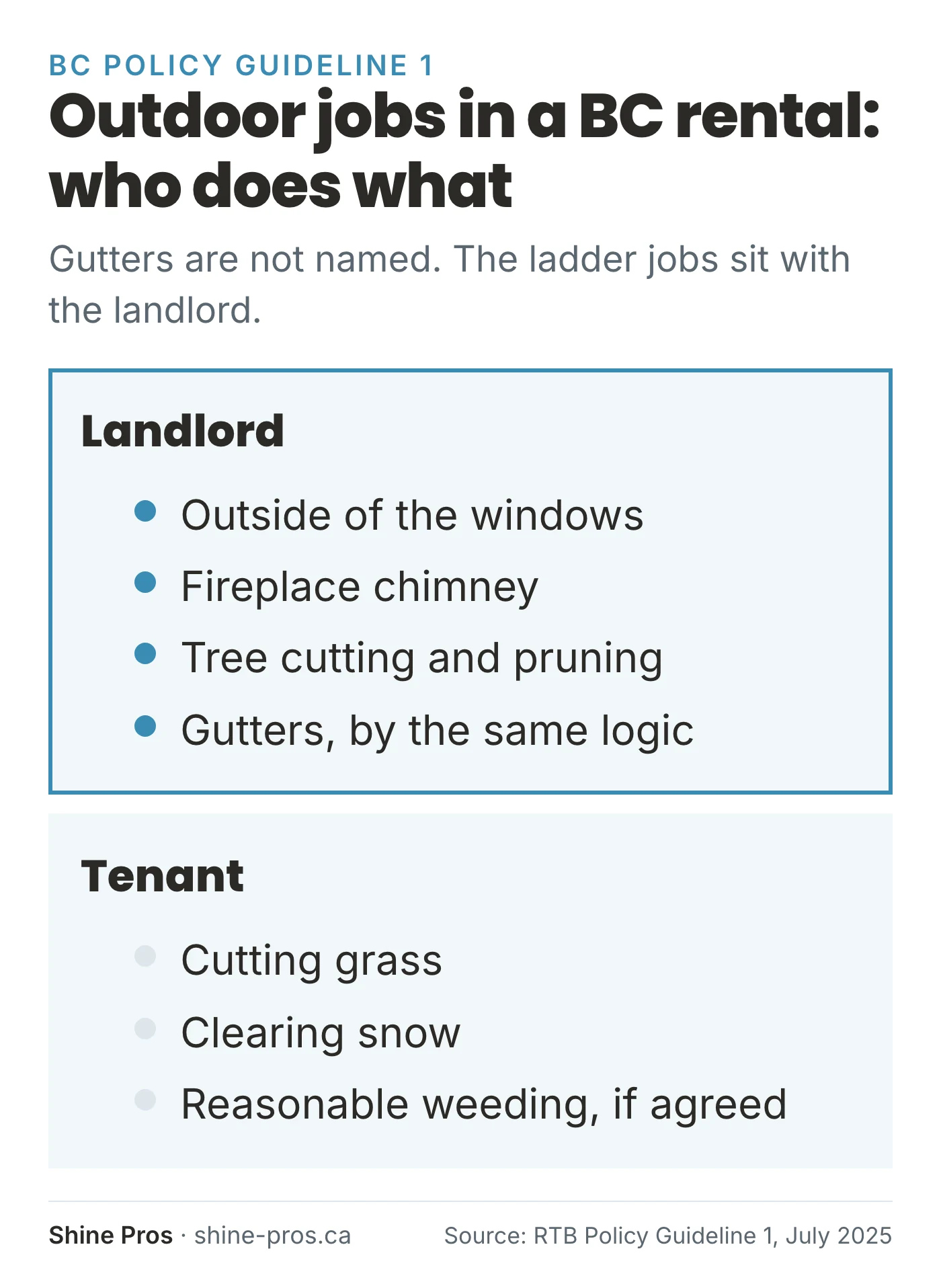
No. Policy Guideline 1, the Residential Tenancy Branch’s guide to who looks after what, never uses the words gutter or eavestrough. So the answer comes from the items it does list, and they point one way.
| Item in Policy Guideline 1 | Who is responsible |
|---|---|
| Cleaning the outside of the windows, at reasonable intervals | Landlord |
| Cleaning and maintaining the fireplace chimney | Landlord |
| Major projects such as tree cutting, pruning and insect control | Landlord |
| Cutting grass and clearing snow at a single-family rental | Tenant, generally |
| Grass, snow and flower beds at a multi-unit building | Landlord |
| Gutters and eavestroughs | Not named |
Every outdoor job the guideline gives the tenant is ground-level yard work. The landlord keeps the outside windows, the chimney and the big tree work, which are the jobs that need a ladder or sit on the building itself. Gutters belong with that second group.
Can a lease make the tenant clean the gutters?
Not easily. Section 5 of the Act says landlords and tenants can’t contract out of it, and any attempt to do so has no effect. Policy Guideline 1 adds that a tenancy agreement can’t include terms that contradict the law. Its examples: a tenant can’t be required to paint or to repair the landlord’s appliances as a condition of renting.
What the guideline does allow is a separate agreement where the tenant does a job in exchange for payment or as part of the rent. So if a tenant is happy to clean the gutters for a rent credit, that’s a legitimate deal. A clause in the lease that simply orders the tenant up a ladder with nothing in return is on much weaker ground. If you’re facing one, the Residential Tenancy Branch is who decides whether it holds.
When does a tenant pay for gutter cleaning?
A tenant pays when the damage is theirs. Under section 32(3), that means damage caused by the tenant’s actions or neglect, or by a guest.
Examples that would fall on a tenant: a ladder they propped against the trough bent it, or they dumped yard waste where it washed into the downspout. Ordinary build-up from the trees over the roof is not in that category.
Can a landlord take gutter cleaning out of the damage deposit?
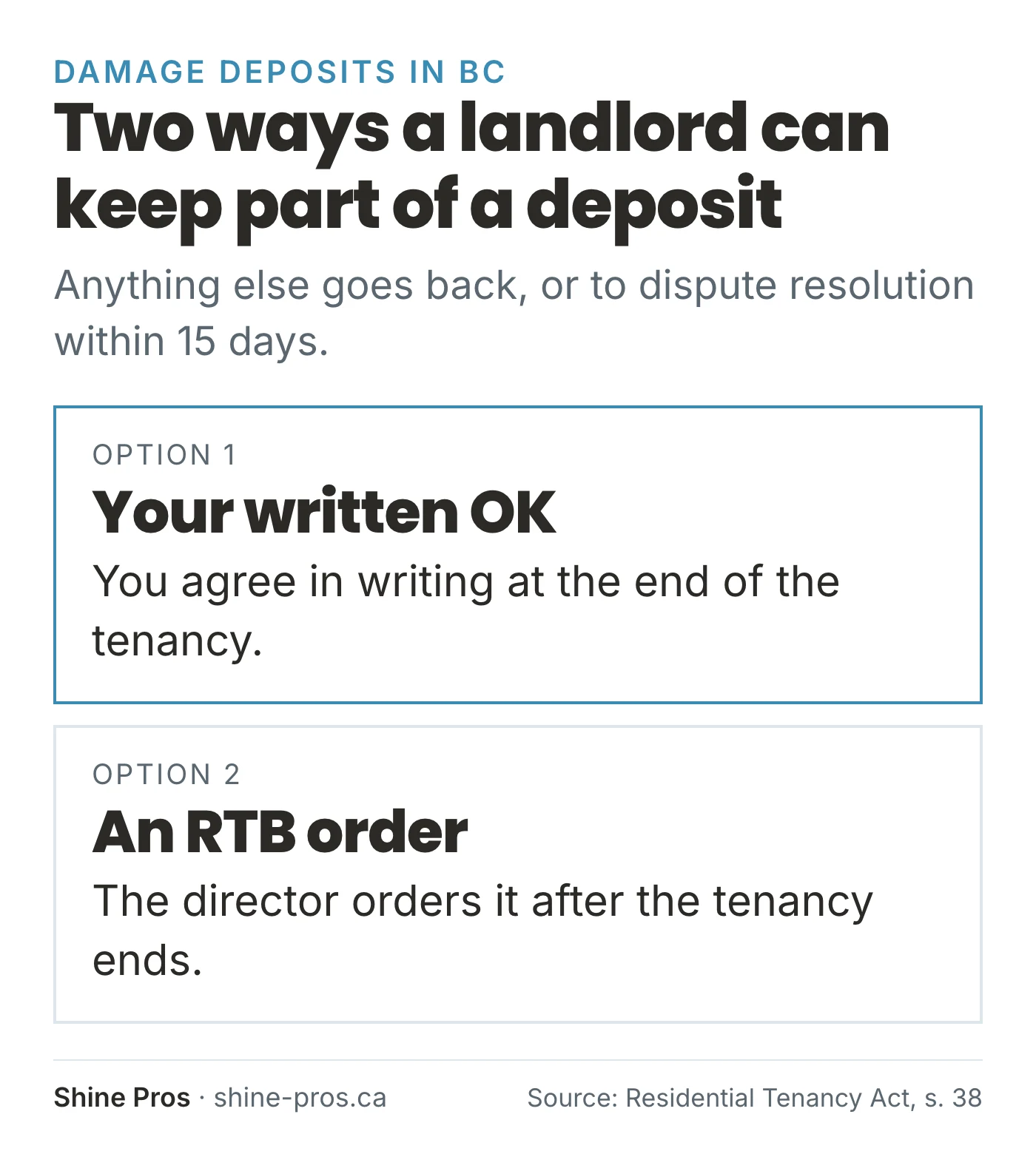
Only with the tenant’s written agreement or an order from the Residential Tenancy Branch. Section 38 of the Act allows a landlord to keep part of a security deposit at the end of a tenancy if the tenant agrees in writing, or if the director orders it after the tenancy ends. Otherwise the deposit has to be returned, or the landlord has to apply for dispute resolution, within 15 days of the tenancy ending or of getting the tenant’s forwarding address in writing, whichever is later.
If a landlord tells you they’re keeping part of your deposit for gutters, you don’t have to sign anything agreeing to it.
Who cleans the gutters in a strata?
In a condo or townhouse strata, the gutters are usually the strata corporation’s job, not the individual owner’s and not the tenant’s. The Province’s guidance on strata repair duties says the strata must maintain, repair and renew common property, including building envelopes.
The Standard Bylaws in the Strata Property Act go further. Bylaw 8 makes the strata corporation responsible for the exterior of a building, and things attached to the exterior, even where that exterior is part of a strata lot. There’s one big exception: that part of bylaw 8 doesn’t apply to bare land stratas, where each owner often looks after their own house. Many stratas also have their own bylaws that replace the standard ones, so check the registered bylaws before assuming.
One James Bay strata manager we work with has referred several long-term customers to us over the years.

What should a tenant do if the gutters are overflowing?
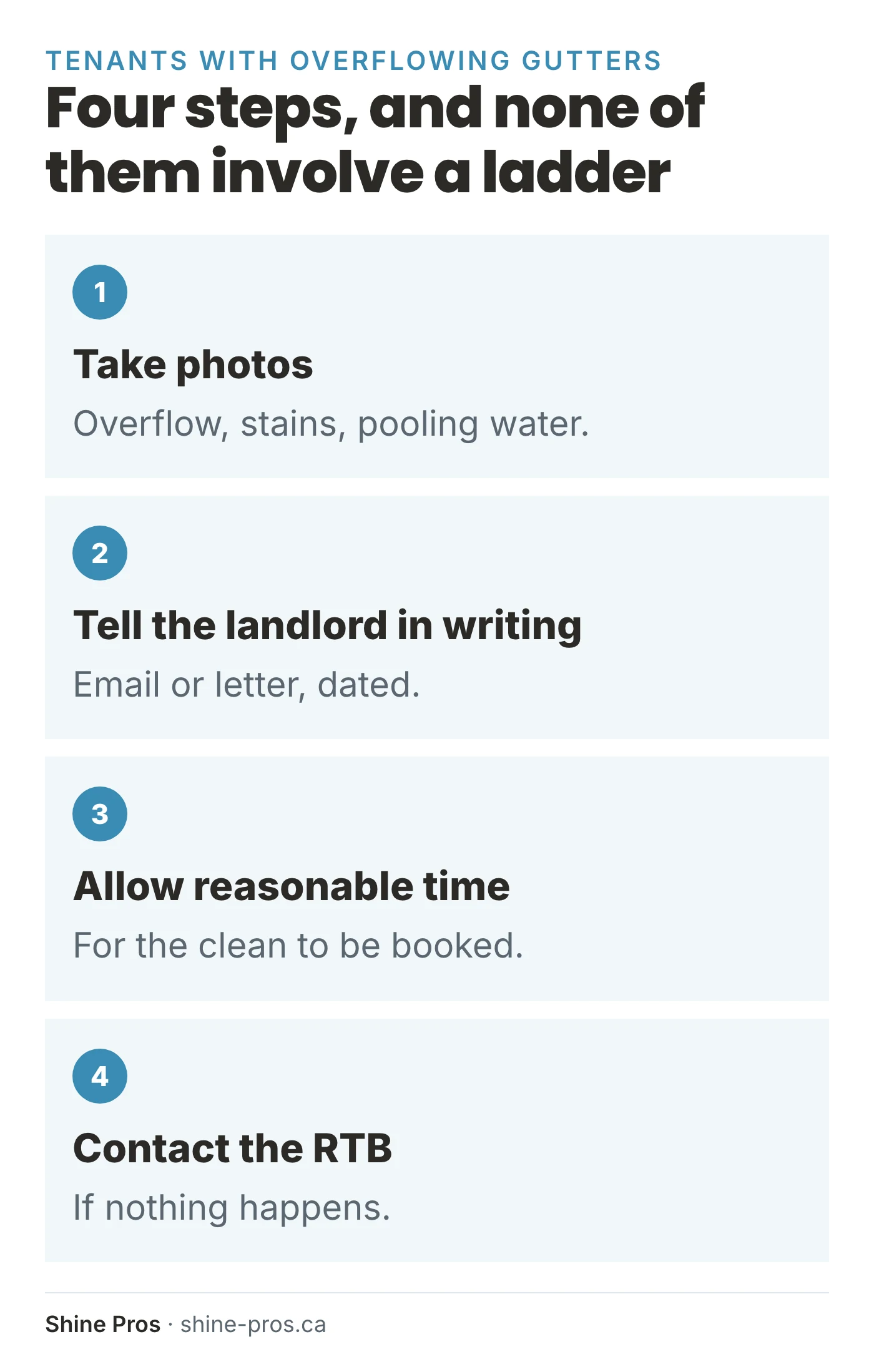
Tell the landlord in writing, and don’t climb up yourself. A dated email or letter with photos gives you a record if water damage shows up later.
- Take photos of the overflow, the stained siding or the pooling water.
- Send them to the landlord in writing and ask for the gutters to be cleaned.
- Give a reasonable amount of time for the work to be booked.
- If nothing happens, contact the Residential Tenancy Branch about dispute resolution.
If water is actually coming through the roof, that can count as an emergency repair under section 33 of the Act, which covers major leaks in the roof. Use the emergency contact your landlord is required to give you.
About the ladder: one of our customers tried to clean her own gutters, fell and broke her back. It’s not worth it on someone else’s house.
What does gutter cleaning cost a Victoria landlord?
At Shine Pros, a gutter clean runs from $235 for a 1,500 sq ft single-storey to $448 for a 3,500 sq ft two-storey, with the exact number given before we start. For a rental under tall firs or cedars, plan on a late-fall clean every year and a spring visit if the trees are close. Our guide to when to clean eavestroughs in Victoria covers the timing. We typically pull 20 to 30 kg of debris out of an average set of gutters.
We’re Alex and Emma, a husband-and-wife team working across Greater Victoria since August 2022. We use ladder standoffs so the ladder never leans on the gutters or siding, carry $3 million in liability coverage and are in good standing with WorkSafeBC, which matters when someone is working on a property you own.
Book a clean or get pricing on our gutter cleaning service in Victoria page. Property managers with several buildings can also see our commercial gutter cleaning in Victoria.
Common questions about gutters in BC rentals
Do tenants have to clean gutters in BC?
Generally, no. Policy Guideline 1 limits a single-family tenant’s routine yard work to things like cutting grass and clearing snow, and the landlord keeps the ladder-height jobs such as outside windows and chimneys. A tenant pays only if they caused the damage.
Is gutter cleaning part of yard maintenance?
Not in BC’s guidance. Policy Guideline 1 describes routine yard maintenance as cutting grass, clearing snow and, where the agreement asks for it, a reasonable amount of weeding. Gutters sit on the building, not in the yard.
Can my landlord charge me for gutter cleaning?
Only if you agree to it or you caused the problem. A landlord can keep part of a deposit only with your written agreement or an order from the Residential Tenancy Branch, under section 38 of the Residential Tenancy Act.
Who pays for gutter cleaning in a strata townhouse?
Usually the strata corporation, paid out of strata fees. Standard Bylaw 8 makes the strata responsible for building exteriors in most stratas, but bare land stratas and stratas with their own bylaws can differ, so check the registered bylaws.
Where can I read the rules myself?
The Residential Tenancy Act is on BC Laws, Policy Guideline 1 is published by the Residential Tenancy Branch on gov.bc.ca, and the Province also has a page on the division of repair duties in a strata. Links are below.